

As has been the case often lately, I find myself in the position of having several recommendable albums with nothing really to link them except that, in my opinion, they display a true enthusiasm about crossing genre-boundaries. These are all, in slightly different ways, conversations.
Well, isn’t all good music?
Still, these are really, really great. I feel like I’ve been extra lucky this past week, just finding slam dunk after slam dunk. My friends: take my advice, pick one of these and give it a spin this week.
Here they all are:
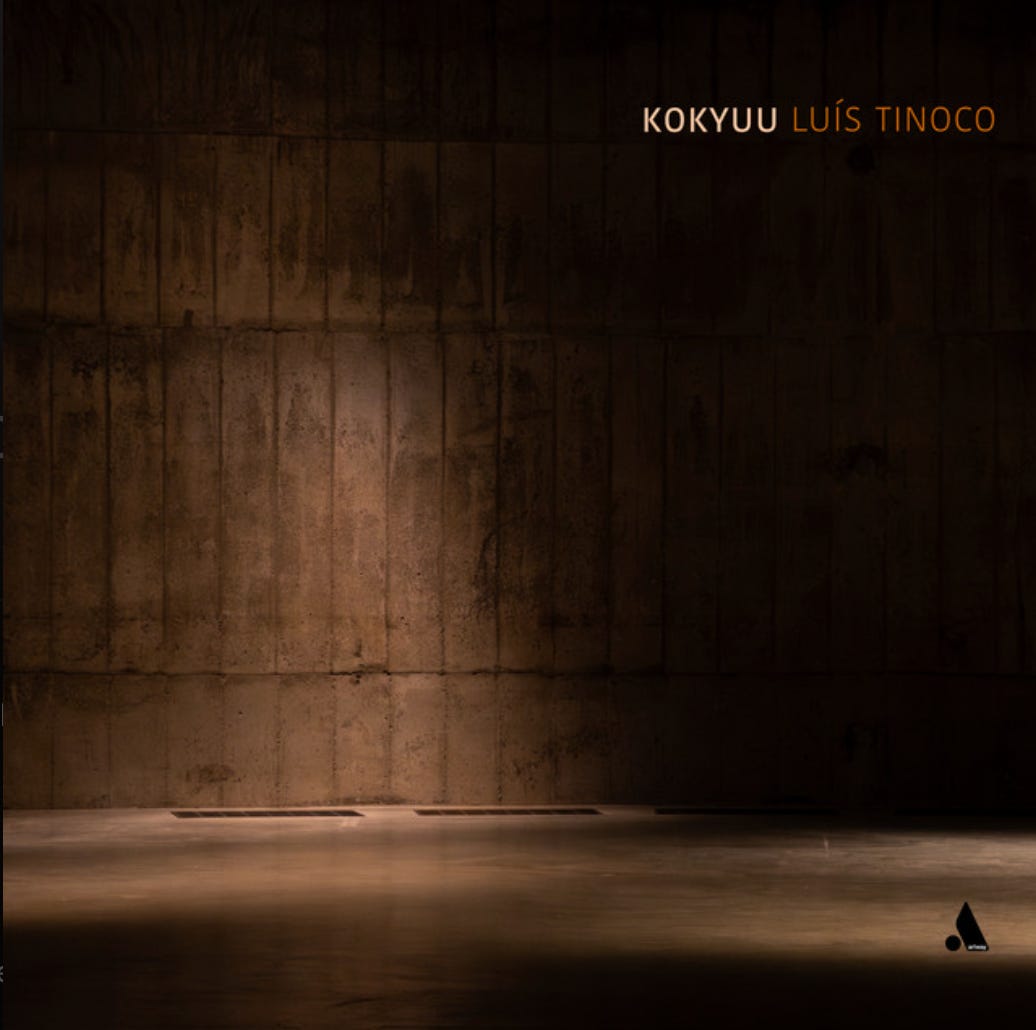
Luis Tinoco (b.1969)
2020 Kokyuu (‘Breath’; concerto for alto saxophone) - 17 '
2022 Cancoes de Trabalho (Three Work Songs) for Soprano and Orchestra - 20 '
2024 Cello Concerto No. 2 (3 movements) - 18 '
2023 Accordion Concerto (2 movements) - 19 '
2019 Entre Silencios (‘Between Silences’; concerto for Clarinet) - 18 '
Ricardo Toscano (Alto Saxophone), Livia Nestrovski (Soprano), Filipe Quaresma (Cello), João Baradas (Accordion), Horácio Ferreira (Clarinet)
Orquestra Metropolitao de Lisboa / Pedro Neves
Orquestra Sinfonica do Porto Casa de Musica / Joana Carmero
Recorded c. 2025, Lisboa & Porto, Portugal
Artway Next0172025 [90]
&
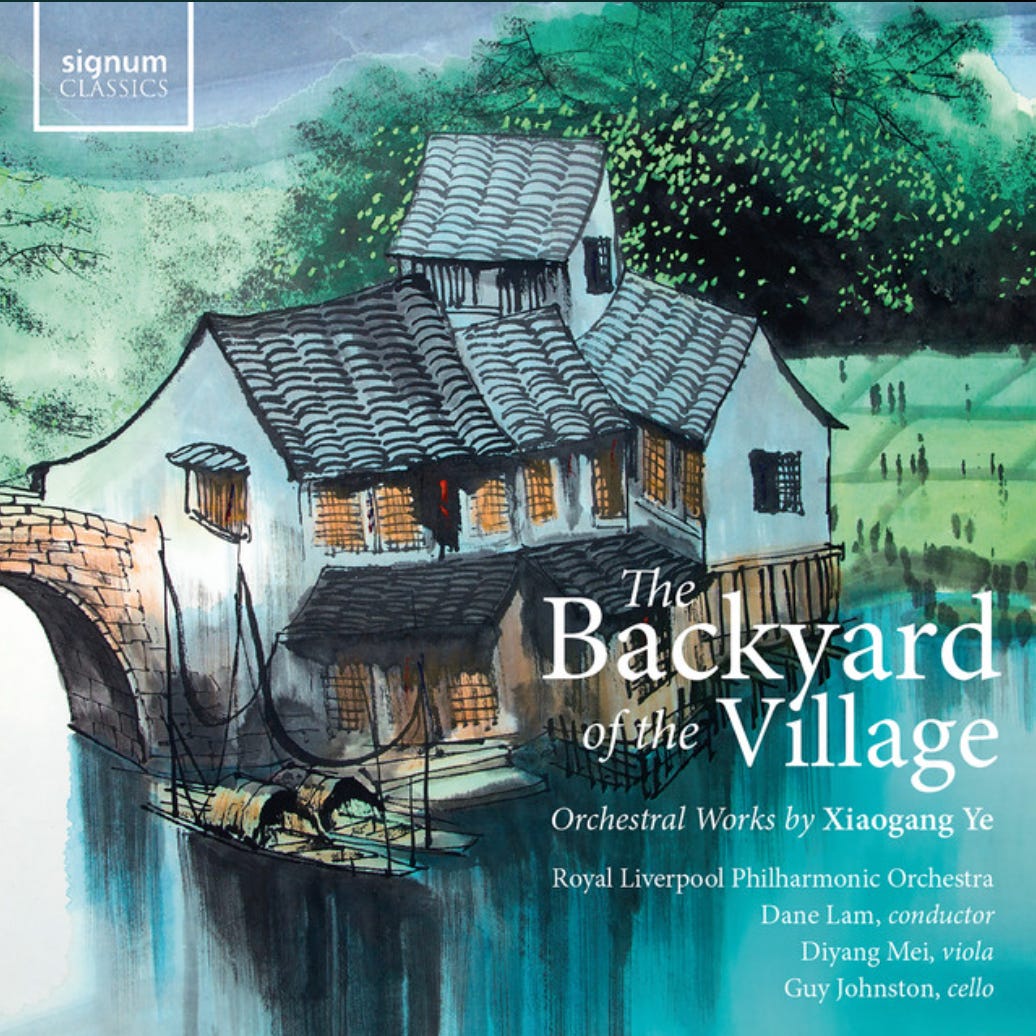
Xiaogang Ye (b. 1955)
2019 The Backyard of the Village, Op. 89 - 13 '
2019 The Memories of Mount Jing Gang, Op. 87 - (viola concerto) 13 '
2005 My Faraway Nanjing, Op. 49 (cello concerto) - 16 '
2024 The Loquat in Five Colors, Overture for Orchestra, Op. 108 - 9 '
Diyang Mei (viola), Guy Johnston (cello)
Royal Liverpool Philharmonic Orchestra / Dane Lam
Recorded 2024, Philharmonic Hall, Liverpool, England.
Signum Classics SIGCD972 [52]
&
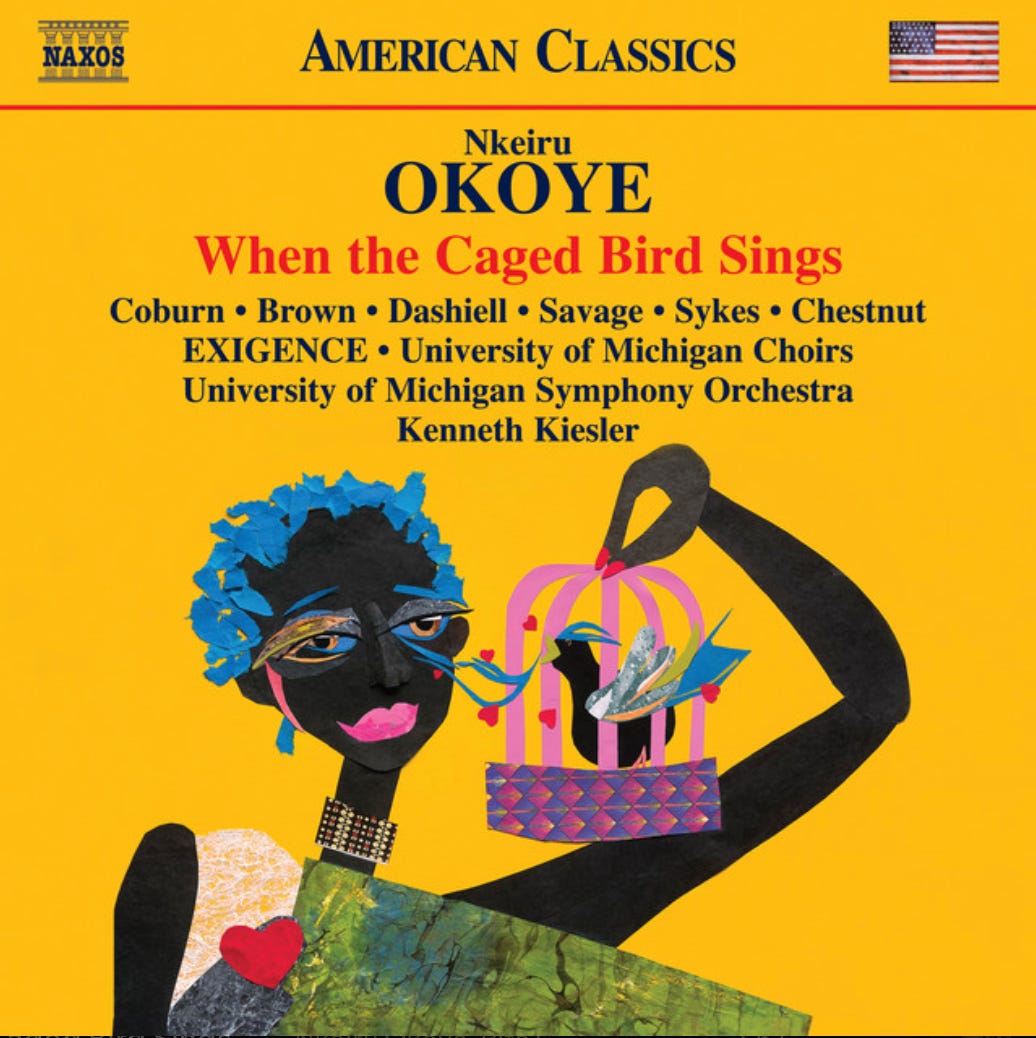
Nkeiru Okoye (b.1972)
2023-2024 When the Caged Bird Sings
Part 1: Gather Together in My Name, 20 '
Part 2: Now Sheba Sings the Song, 21 '
Part 3: And Still I Rise, 12 '
Part 4: I Shall Not Be Moved, 12 '
Part 5: A Song Flung Up to Heaven, 14 '
Rita Coburn (Spoken Voice; Celebrant), Angela Brown (Soprano; Mother), Christie Dashiell (Mezzo-Soprano; Cerise), Issachah Savage (Tenor; Guidance Counselor), Jubilant Sykes (Baritone; Father), Cyrus Chesnut (Piano; Minister of Music)
Exigence: A Sphinx Vocal Ensemble
University of Michigan Choirs (Chamber, Orpheus Singers, University Choir) / Eugene Rogers
University of Michigan Symphony Orchestra / Kenneth Kiesler
Recorded 2025 (?), University of Michigan (?), USA
Naxos 8.559953 [78]
&
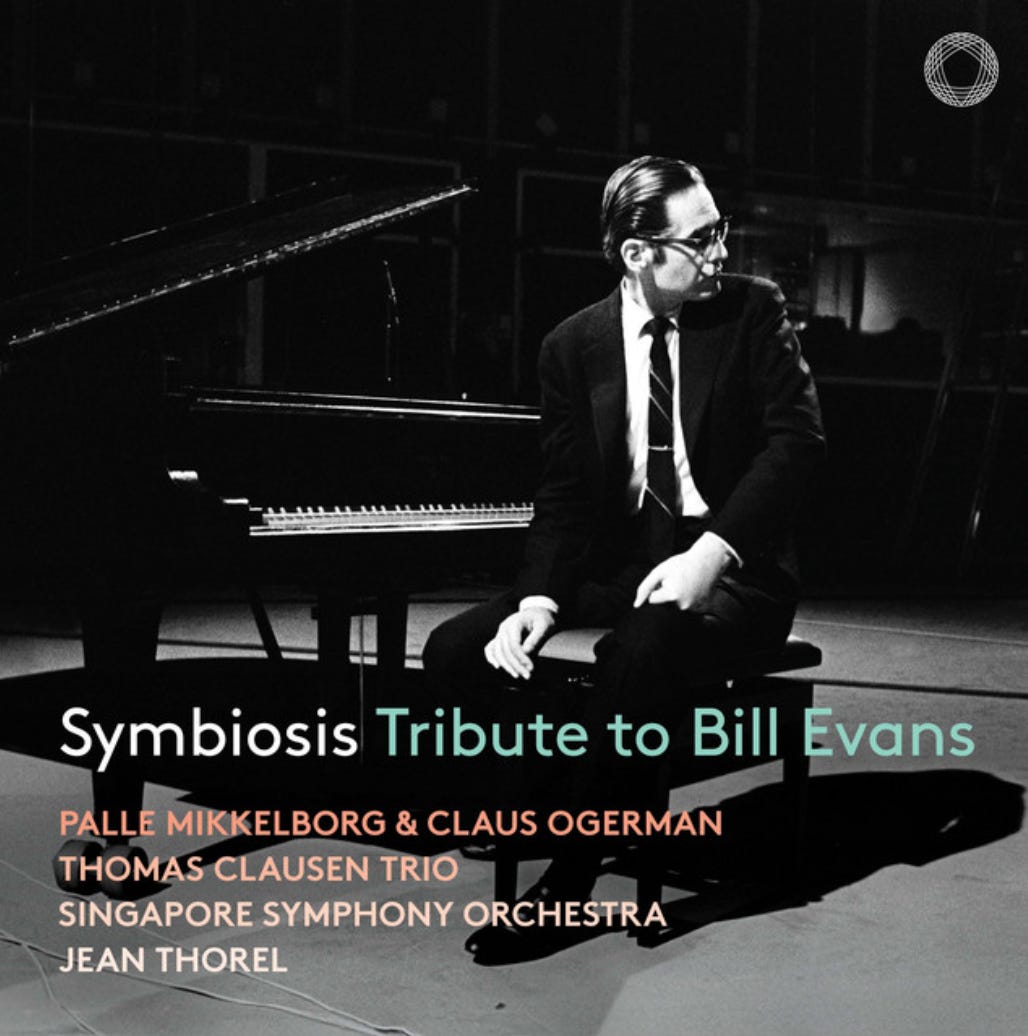
Palle Mikkelborg (b. 1941)
1969 Bill Evans Suite (for Orchestra + Jazz Piano Trio, 6 movements) - 31 '
Thomas Clausen (b.1949)
2023 For Pi (for Jazz Piano Trio) - 6 '
Claus Ogerman (1930-2016)
1974 Symbiosis (for Orchestra + Jazz Piano Trio, 2 movements) - 44 '
Thomas Clausen Trio (Piano, Double Bass, Drums)
Anders Malta (Trumpet)
Singapore Symphony Orchestra / Jean Thorel
Recorded Jan. 5-7, 2023, Live at the Esplanade Concert Hall, Singapore
Pentatone PTC5187510 [80]
&
Didem Başar (b. 1974)
Echoes of the Throne Room (Orch. by Judith Steenbrink) - 5 '
Tineke Steenbrink (b. 1977)
Frate Vento - 5 '
Angelus Bells (Orch. by Judith Steenbrink) - 4 '
Walking in the Desert - 8 '
Judith Steenbrink (b. 1977) & Dimitrius Cantemir (1673-1723)
Heaven Lives in the Other - 4 '
Judith Steenbrink (b. 1977)
Welcome - 4 '
Lauda - 5 '
Sia Laudato San Francesco - 5 '
Ufki (1610-1675)
Muhayyer Semai (Orch. by Judith Steenbrink) - 4 '
Tabassian (b. 1976)
Bood Amma Naboud (Orch. by Judith Steenbrink) - 6 '
Dream of Hope (Orch. by Judith Steenbrink) - 8 '
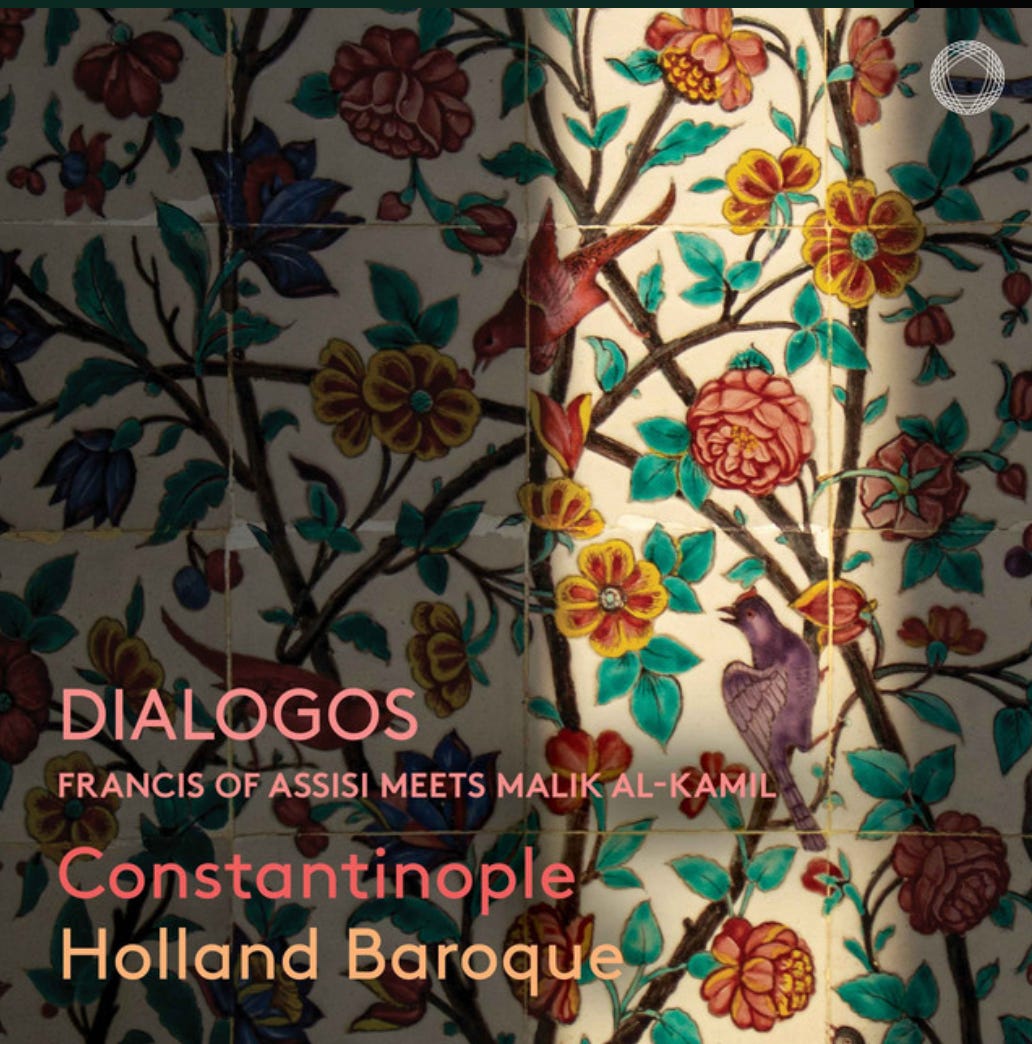
Constantinope, Holland Baroque
Pentatone PTC 5187495 [58]
(technically a live performance video but come on!)
I’ll start with Portuguese composer Luis Tinoco. I’d actually heard him before—I think 2 separate albums of his work—and I confess to not getting it at all. I know this substack gives the impression that I sort of like everything, but that’s not true at all: I just don’t see the point of spending time to give a lukewarm, or even negative review. But my first encounters with Tinoco left me feeling like I was missing something.
But one of my listening creeds is to keep revisiting things, because you never know when something’ll click. For me, this double album of concertos is what made Tinoco click, and I am delighted to recommend it to you.
In a sense, every work presented here is rather similar, and I will sort of treat them as a single mass. Before anyone objects to that remark, or feels that it is a slight against Tinoco, I don’t agree at all: there are a lot of great baroque & classical composers who had a particular style, and mostly wrote in that mode. But it is a fact that all 5 of these concertos are sort of sparse, shadowy, not actively dissonant but very light on melody. Instead, you get a lot of atmosphere, a lot of texture. You could probably fairly compare Tinoco to Brian Eno, but heavier.
I think, by the way, that’s why I prefer my Tinoco orchestrated rather than chamber/solo instruments. The weight of the orchestra gives these soundscapes an immersive quality. There’s something very noir about the saxophone concerto (almost certainly on purpose), something very rainy and nocturnal, with a sort of occasional timpani pulse…
Tinoco’s solo instruments stand out from the orchestral backdrop by these moments of color and flashes of directionality, none of which is long enough to be described as a tune, but which really do make for fascinating and deeply evocative listening.
Let me also highlight as a favorite piece the 3 “Work Songs”. They are certainly cut from the same cloth as his concerti, but Livia Nestrovski is able to create so many shades and nuances within them. What a singer she is, by the way! Worth bookmarking her to follow her future work, I’d say.
The Tinoco concertos remind me of the very best of abstract, contemporary art. There’s a lot of unusual colors and imposing, block-like forms, and I think you can’t help but feel a little disoriented: but in a very good way. You could have these as background music but resist the impulse; I promise it’s worth it.
Xiaogang Ye or possibly Ye Xiaogang, depending on how you want to do the whole name thing, is a contemporary composer with at least 7 symphonies composed since 1985. His emphasis is undoubtedly on Chinese culture and history: he has a Great Wall Symphony, a Cantonese Suite, Sichuan Image, a Pipa Concerto, etc. He also apparently has a ‘response’ to Mahler’s Song of the Earth but more, like, actually Chinese. I love that work, but Ye is correct that Mahler’s music is only passingly Chinese. Hm. Ye. Okay, that’s a bit funny, given the other musical artist known as Ye.
Paul RW Jackson in his MWI review points out that Ye has a more ‘popular’ and a more ‘adventurous’ style, and this disc collects 4 works in the former category. I previously heard, and loved Ye’s Songs of Farewell without Words, I think I would put that inching more towards ‘adventurous’. But frankly, there’s no need to discriminate: if anything, I think it’s probably a great sign of genius to be able to write both compelling accessible music and daring, complex music.
Let’s not get carried away; I don’t think I’d call any of this ‘light music’. It’s tuneful and accessible, but you’re still ultimately hearing something original. I actually think a comparison to the French modernist composers would not be out of line. There were several moments during these lovely tone poems where I thought “here’s a successor to Debussy”. Tell me if Backyard of the Village doesn’t remind you of La Mer, sort of.
The Memories of Mount Jing Gang is a sort of viola concerto elegy (for a battle from the Chinese Civil War). And let’s pair that with My Faraway Nanjing, which is a cello concerto written to commemorate the Japanese invasion of Nanjing in 1937. Do not expect screaming romanticism for Ye’s commemoration of either of these massacres. His style is much more lyrical, subtle, and prone to these sort of contrasting interludes which, I believe, are meant to depict the environment surrounding the battles. It’s an interesting approach, and I’d understand if the listener did not feel like these were, subjectively speaking, elegiac. But I think they gain a dimension if you try to understand the understated, almost serene way that Ye pays tribute to these atrocities. There’s something, dare I say, ‘classical’ about it, and then as purely musical works, these are both so gorgeous and watercolor-y. The viola sounds a good bit like the erhu, in fact, I’ll admit, with apologies to all Chinese music fans, that I actually thought this was an erhu concerto — but, see, this is a really interesting feature of Ye’s blending of Chinese and Western musical traditions. It doesn’t need to be an erhu, because it’s erhu-ic writing for the viola. See? No, I don’t think that’s the adjectival form of erhu, I just wish it was.
The last piece is an overture based on a region of the North China plains, I believe, and it’s got that kind of…. Smetana/Dvorak/Grieg approach— colorful, lyrical, folky, and quite lovely.
If you don’t know this Ye, start with this album, and if you do, this is one of his very best.
Number 3 brings us to Nkeiru Okoye, my favorite of the 5 I’m offering today. All are special in their own, different ways, but this one really has my heart.
This is the first full album dedicated to Okoye (thank you, Naxos!) but I knew I recognized her name from somewhere: she’s featured on Kaleidoscope, which is a first-class piano recital from 2024. Isabel Dobarro was the pianist.
Anyways, there’s a difference between hearing a 3-minute sketch for piano and a full-length oratorio, so this is really the recorded world’s introduction to Okoye.
First I have to talk about the genre. This is an oratorio, as in, a genuine, actual, religious oratorio. The musical antecedents are, according to Okoye, Black religious music in America, rather than Lutheran hymnody, but it is a successor to the works of Handel and Bach, and more recently, I suppose, Tippett (I actually think this would make fascinating paired listening with Child of Our Time, which also draws on Black music). The theme is explicitly religious, the plot concerns a young woman named Cerise growing up, facing racial bullying & discrimination, and learning to trust in God’s plan for her life and celebrate her identity.
I’m going to go on record as saying that’s an excellent story for a contemporary oratorio.
And, with that, I want to just briefly mention the libretto—to get everything else out of the way before we go on to the music. Okoye’s concept was to use the poetry of Maya Angelou, which is, again, a fantastic idea. This is mixed, then, with religious texts—prayers and hymns and such. I think perhaps the libretto strays from excellence in some of the non-poetic spoken word sections: but, this is a minor quibble.
But, that aside, what an incredible musical experience this is. Okoye is a genuine polystylist. Many people want to be polystylists, but most lack the talent & encyclopedic interest to pull it off. But Okoye genuinely goes through about 4 different genres per minute, and she keeps that rate up throughout the piece, which hugely contributes to the sense of exuberance and universality. This is a piece of music that aims to encompass quite a lot: Okoye has described it as ‘celebrating and uplifting black women’.
It would be impossible and inadvisable for me to try to list all of Okoye’s influences— you get a lot of gospel, a lot of opera, a lot of gorgeous orchestral writing, moments of minimalism, some jazz piano…
This is a beautiful, profound, ultimately hopeful yet-unafraid-to-consider-darkness piece of eclectic music. It’s that sense of play and inspiration that make it so fantastic, I think. I suspect it will end up being one of 2026’s best, so go listen now!
I think my second-favorite from today’s list is Symbiosis.
If you don’t know Bill Evans— of course you do, right? Bill Evans. The jazz piano guy. He’s on the 1 jazz album that everyone knows, Kind of Blue.
I have always loved Bill Evans’ solo career, I think he managed to create some of the most profoundly sad music in all of jazz— You Must Believe in Spring, for example. Much earlier, you have Waltz for Debby, Conversations with Myself, and the super-famous Portrait in Jazz. I think these are all masterpieces.
I think also, by the way, that there’s always something very tricky in talking about Bill Evans. James Kaplan talks about this in his 3 Shades of Blue, which I read last year. Fun book, by the way. Evans was kind of an outlier in the world of ‘50s and ‘60s hard bop, in that he had a particular style informed directly by classical composers, especially Debussy. Not, by the way, that this interest would have been unusual. All the jazz greats listened to & enjoyed the major 20th-century composers. This isn’t the place to go into more depth there, but—
Sometimes Bill Evans, I think, is given too much credit for being a classicist, because he was one of the very few white musicians in the golden age of Jazz. Yet, that was inarguably how he developed his style: and it was not how most other jazz musicians developed theirs.
So the problem becomes when listeners attribute to Evans particular sensitivity, feeling, depth: these kind of nebulous terms that sometimes, but do not always, stem from implicit (or, explicit) racism. His compositional style is deeply impressionistic, it is, maybe, a little colder and more introspective than many jazz pianists, and probably has a lot more Zen philosophy in it (Evans was deeply interested in Eastern religions).
If all of this sounds like a very fussy preamble, it’s because I both adore the music of Bill Evans, and have always harbored suspicions that he essentially just benefits from being a white guy who plays jazz having come from a classical background.
But, alright, none of this makes Evans invalid as a musician, and in fact it sets him up very nicely for classical composers to play with. And play they did: Palle Mikkelborg in 1969 composed a suite for orchestra + jazz piano trio based on themes from pieces by Evans.
I’ve read 2 different reviewers who were a bit sniffy about Mikkelborg’s writing. It is kind of…of its time, maybe a touch saccharine and “sweeping”, but I honestly think the transitions into jazz kind of balance this out a little. I loved it, and if that makes me tacky or tasteless, so be it! Note too that the pianist in the jazz trio here is not Bill Evans, who was unable to attend these recording sessions, being dead. Thomas Clausen plays here instead, and, very big shoes to fill but I think he’s really up to the task. Not everything he plays sounds exactly like something Evans would have played, but, who would want that anyways? It’s what it says on the album cover: a tribute.
For PI is, begins as, a ‘pure’ jazz track, for piano trio + trumpet, and, it sorta made me go “aw, I want to listen to more jazz this year”. It has some very light orchestral touches, particularly to the end, and I guess they are less sugary than Mikkelborg’s, but in a similar vein, if we’re being honest.
Finally, Symbiosis, which was composed by Ogerman in 1974 for an album on which Evans played. It was in that whole era of what is called “Third Wave Jazz,” where composers and jazz musicians were interested in trying to marry improvised jazz with composed-classical music. My impression is that at the time, both camps wrote these experiments off for the most part (with the exception of Davis’ Sketches of Spain) but I think we’re due a reevaluation. I think a lot of these might be really interesting. Symbiosis is, anyways.
As I understand, there were some issues with the scores, which have not survived, but musicologist Ding Jian Han has reconstructed the score from the performance on record, which sounds both kind of fun and also unbelievably aggravating. Anyways, so, what that basically makes this, I suppose, is nothing more complex than a rather unique Piano Concerto with cadenzas composed by Bill Evans. Well, it’s a truly remarkable one. I suppose it’s significantly more jazz than classical, but the orchestra is very, very much appreciated, and they acquit themselves well.
Hey, while we’re on the subject, this is the Singapore Symphony Orchestra, whose Mozart Violin Concertos with Chua in 2025 are a personal reference recording.
Let’s close out on something very different.
Constantinople are an ensemble specializing in medieval Persian & Ottoman music, and then Holland Baroque are obviously a European early music outfit. They’ve come together for an album inspired a 1219 meeting between St Francis of Assisi and Sultan Malik Al-Kamil during the 5th crusade. This was an attempt at an interfaith dialogue, as the album title implies.
So that’s the theme. East meets West in early music. The lyricists include Ali Ufki (born Wojciech Bobowski) a Polish poet who became an Ottoman citizen in the 17th century, as well as 20th century poets. Some fun characters here. It’s got kind of a bit of everything in it.
I am not an expert in early music from any locale, and in fact I usually avoid it. But I took a chance here because I thought the story seemed interesting and cute. Man, did it pay off! The music here is so fresh, enthusiastic, and fun, I don’t see how it could fail to win over any listener. I guess, though, in a way, this isn’t quite early music: I am unclear on the exact genesis of these pieces, but they all seem to have been composed by someone born quite recently. I do not know if they are based on traditional tunes, or, what’s going on here. It certainly feels both authentically centuries-old, and yet, I would also believe that they were written to give that impression or feel. I guess what I’m saying is if I ever make a film about, like, a Silk Road merchant traveling from Samarkand to Rome, I’m hiring these two groups. A lot of it does actually feel quite cinematic.
I think the instruments used are pretty fun, too. I don’t know what all of them are, but there’s some lovely lyre-like sounds, some bowed things, various kinds of flutes, church bells. The vocals are mainly, I think, Eastern rather than Western, but that works fine because that is just a beautiful vocal tradition. There’s also a lot of fun percussion, which I appreciate. Nothing too obtrusive, but it all contributes to the sense of a festival.
Whoever wrote it, and when, the main essential thing is just how exuberant, how well-paced, well-recorded, and vibrant each and every track is. There’s a real kind of party atmosphere, a sense of joy and energy and vividness.
Something that I’ve always said is that whatever political relations may exist between two cultures, nations, races, or groups, the musicians probably like each other. Art recognizes art, and being committed to an art often (but not always) forces you to have a grudging respect for other arts, even ones very different from your own. It would be too much to extrapolate from that that art is the key to political harmony, but, I don’t think it’d hurt either. So, yes, it’s sort of sweet to think about all these different dialogues— solo instrument + orchestra in Tinoco, China & Western Classical in Ye, Gospel and Opera in Okoye, Jazz and Classical in Symbiosis, and, of course, Europe and the Near East in Dialogos.
Five wonderful albums. Been a great week for music, for me.
Have you heard any of these? Do you agree or disagree with my reviews? Are you curious about them to look any up? Let me know what you think in the comments!
(Pictured: Nkeiru Okoye)
